

Featured Studies

Office of Patient Recruitment

This web page makes it easy to search for featured research studies at the NIH Clinical Center. You can search for specific studies by entering keywords related to your symptoms in the search box or by using the sort and filter options.


To view a full list of all studies conducted at the NIH Clinical Center, visit Search the Studies.

Filter By

Visit Type

Patient or Healthy Volunteer

Age Group

Web Page Language

11 results
Close-up portrait of a woman with a sorrowful expression, illuminated against a dark background, evoking feelings of loneliness and mental distress

A Feasibility Study of Transcranial Electric Stimulation Therapy (TEST) for Treatment Resistant Depression (TRD)

Dr. Regenold and his team at the National Institutes of Health (NIH) are leading a study to explore an investigational new, non-invasive brain stimulation technique to see if it can safely support people experiencing symptoms of depression.

Learn More
3D medical illustration depicting human kidneys and blood vessels, rendered in a polygonal, interconnected design

A Study of an Investigational Drug for Focal Segmental Glomerulosclerosis (FSGS)

Dr. Gahl and his team at the National Human Genome Research Institute are seeking volunteers aged 18 and older with primary FSGS to participate in a research study on the effects of an experimental drug, ManNAc, on this disease. The study aims to assess the long-term safety and tolerability of ManNAc and determine whether it can reduce protein in the urine of people with FSGS.

Learn More
Close-up of a woman looking out a window, reflecting a sense of loneliness

An Investigation of the Antidepressant Effects of (2R,6R)-HNK, an Enhancer of Synaptic Glutamate Release, in Treatment-Resistant Depression

Researchers at the National Institute of Mental Health (NIMH) are studying an investigational drug, HNK, to see if it is effective in treating major depression. If you're 18–70 years old and have major depressive disorder (MDD), you may qualify for this 12- to 14-week inpatient research study.

Learn More
a man and woman smiling while viewing a laptop together

Families SHARE: Virtual Reality Study

Research study #IRB002325 is testing a new virtual tool that helps people learn more about their health and family health history. The goal is to build knowledge, skills, and confidence in talking about health within families.
Learn More
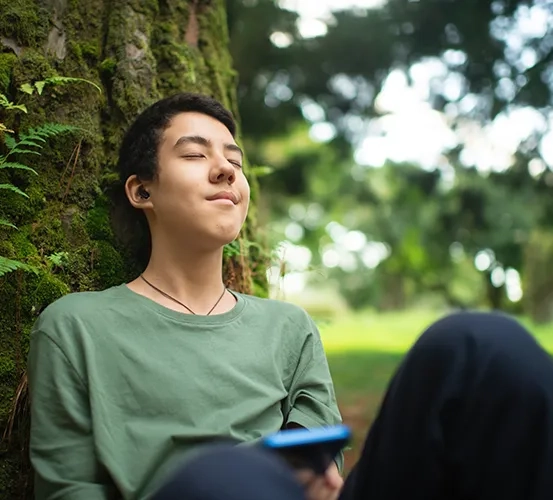
A child sitting in the park listening to music on headphones

Role of GABAergic Transmission in Auditory Processing in Autism Spectrum Disorder

Researchers are studying the brain's response to language and sound. This study uses a repetitive transcranial magnetic stimulation (rTMS), an investigational form of brain stimulation, to measure how different parts of the brain communicate in teens with autism spectrum disorder (ASD). Findings from this study may aid in the development of possible future treatments.

Learn More
Genomic Services Research Program

Genomic Services Research Program

Genetic testing sometimes tells a person or family unexpected results. These genetic test results are unrelated to the initial reason why the testing was done. These kinds of results are called "secondary results" or "secondary findings." If you or a member of your family have been given a secondary result please consider partnering with us on this research.
Learn More
A Longitudinal Investigation of the Endocrine and Neurobiologic Events Accompanying Puberty

A Longitudinal Investigation of the Endocrine and Neurobiologic Events Accompanying Puberty

Your healthy 8-year-old child is invited to participate in an NIH outpatient research study that examines how puberty affects brain development.
Learn More
The NIH Mini Study: Metabolism, INfection and Immunity in Inborn Errors of Mitochondrial Metabolism

The NIH Mini Study: Metabolism, INfection and Immunity in Inborn Errors of Mitochondrial Metabolism

Researchers at the National Human Genome Research Institute (NHGRI) are seeking healthy children between 2-17 years old to participate in a research study to better understand the immune system of patients with mitochondrial disease in comparison to their healthy peers.
Learn More
Was this page helpful?