



 Sign up to receive email updates for NIH Clinical Center Podcast
Listen and Subscribe to Discovering Hope in Science
On this page:
Featured Speaker: Dr. Brad Wood | Show Notes | Episode Transcript
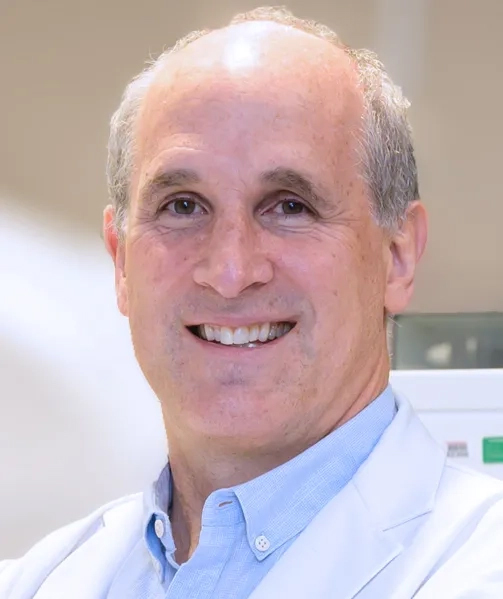
Dr. Brad Wood is the founding director of the Center for Interventional Oncology and the chief of Interventional Radiology at the NIH Clinical Center.
Show Notes
- Center for Interventional Oncology
- Faraday Cage
- Fusion Technologies for Image-Guided Robotic Interventions
- Interventional Radiology
- RadioFrequency Ablation (RFA)
Episode Transcript
[Background Music]
Intro: From the National Institutes of Health Clinical Center, this is Discovering Hope in Science.
Dan Silber: Welcome to Discovering and Hope and science. I'm Dan Silber. I'll be your host today. Today I'm with Doctor Brad Wood, senior investigator at the Center for Interventional Oncology at the NIH Clinical Center. Thank you so much for being with us.
Dr. Brad Wood: Absolutely. My pleasure.
Silber: So today we're talking about ...
Wood: And you didn't introduce my coffee. Very important part of the team.
Silber: Absolutely. What are you drinking today?
Wood: Anything? Caffeine.
Silber: I heard that this morning, you were performing an ablation.
Wood: This morning, we did an ablation with, robotics, which is pretty cool. And robotics and image-guided therapy in general And interventional radiology. Interventional oncology provides a level of standardization, automation, reproducibility that's really important for the field. It's important to be able to get a uniform treatment out to the public.
Silber: What are some of the challenges in that process?
Wood: Humans. Humans are always the problem, right? No, it's, it's, I say that facetiously, but, hand-eye coordination is a skill set. Takes some time to, improve on. And in the grand scheme of a long career and ideal and ideal setting, everybody would be able to do this procedure in a, similar fashion with a level of exquisite accuracy that lets you hit a pinpoint, immediately in three seconds from way away with a long chopstick of a needle and an ablation device which cooks the tumor, for example. Every time. And if you can do that every time in 10 seconds, it should be better than any human factor, which is subject to the variability of how much coffee you had that day. What's going on in the procedure room, you know, all kinds of different, variability skill sets.
Silber: So, how do robots assist in this process?
Wood: So a robot lets you implement the actual treatment plan. So let's you start soup tonight. Start to finish thinking about how to approach a, in this case a cancerous lesion that you see on a CT scan or an MRI or Pet scan. Let's you approach that problem in a mathematical way and lets you get from a scan entry to a tumor in exquisite accuracy and precision, both, very rapidly. So let's you implement a treatment plan and then, let's you go back afterwards and look and verify that you've actually, confirmed that you've got your margin, that you've treated what you set out to do. And that's a very important part of the whole process for tumor ablations, which is it's we're learning now, that that is a critical piece of quality ablation. And to do so without that element is a little bit less quality and a little bit less about less favorable outcomes. And, this just makes sense.
Silber: Recently, you had published this article Fusion Technologies for Image Guided Robotic Interventions. And, I was hoping you could walk us through that a little bit.
Wood: I guess, fusion technologies is the ability to register a fuzed match or bring multimodality, information together when you're doing things to the patient. For the patient, with the patient, at the patient's bedside, at the time, you need that information most, which is when you're treating the patient. So if we have exquisite XYZ coordinates of exactly what that spatially looks like, that patient and that organ and that tumor in relation and all the anatomy in relation to each other, you're it just makes sense that you're going to do things better, and you're going to be able to have better outcomes. So this technology has evolved, largely over the past almost three decades. And it's really, you know, technology takes a long time to actually, be adopted. And, this has been adopted and little pieces, little elements and little bits and pieces, but it's still realizing its full potential and being able to use all that information in dance between multiple modalities. Functional or metabolic image versus an anatomic, morphologic image. And there, you know, there's different information. And being able to have all that information at your fingertips when you're placing a needle or catheter, or devices or drugs to a local area, it just makes sense. It makes beautiful sense. And it's actually based on a combination of the physical and the biological sciences. So high school physics, much of this is which some of the devices that we use are electromagnetic tracking which goes back to the Faraday principle, which is something we learned in high school physics, where you have a tightly wound, wire and the presence of a magnetic field is very weak magnet fields, not like an MRI, elicits electricity. That electricity varies according to where that magnet is pointing. And if you alternate those magnetic fields rapidly in a very subsecond, basis, it elicits a little different electrical current because magnetism, electricity are related. That's the high school physics part. What we do with this is it turns a device, an ultrasound, a needle, a patient's chest, a robot, a catheter. It turns it into a, tracking device, like a GPS on your phone so you can see where you're going in your car. And to do this, to do these procedures, image guided therapy. Without this technology or similar technology. Like it, it's like driving a race car through the, you know, Italian Alps without your headlights on at night. And then all of a sudden you have the technology and you see where you are in real time while you're doing this at the procedure, it's really eye opening.
Silber: And then how did you sort of decide to follow this particular, set of modality or the set of technologies?
Wood: The development inherently is, what NIH is best suited to do in the intramural research program, especially. And what we do well is interdisciplinary thinking and interdisciplinary, multidisciplinary science team science brings different roles together to the table, shoulder to shoulder. And the currency is the discovery, the innovation. The paper sometimes, but it's, it's the ideas, that's our currency. We don't we're not getting paid by the patient. We're trying to develop things to improve and meet an unmet clinical need and address that need with technology. So in that case, you're bringing the benefits of multiple-specialties, disciplines, thoughts, processes, ways of thinking. In this case, it evolved from biomedical engineering, interventional radiology, medical oncology, surgical ecology, urologic oncology. And coming together in a place like NIH lets us, take advantage of each of those assets and skill sets and expertise without having to own the patient, without having to, compete for anything. We're in this together. Everybody comes to the table. Team science at its best.
Silber: It's amazing and very inspiring. What next? I mean, that's one thing here, but what's the next stage for the the suite of technology?
Wood: Well, I think, one thing that people don't always realize and medicine and science, I think is, the clinical adaptation, the adoption and the translation. What's the uptake ratHow do we get it out to the community setting? How do you get out to a global setting? How do you get it out to that, to the rural practitioner or the non-hospital practitioner? And that's sometimes that's that's a hardest to appreciate. But it's the most important because it actually determines the impact. And an impact is only as good as a technology gets adopted. So if we see many technologies that are overengineered and and expensive or get sequestered into just high end users and, certain facilities, and that goes against the grain of what we should be about and what we are about, and that's getting the public health dollars spent in a good fashion, to meet the needs of the public and the public health as a whole. And so getting it out in the community, getting it commercialized. We have, we take advantage of the Bay Goal Act, which allows for cooperative research and development agreements. That's a fancy way to say we can jump in with industry and take an idea, implement it, get it, check it out, and patients prove that it meets an unmet clinical need and help them to prove its value, help them to commercialize it. Help them to get it into a setting, into a platform that makes sense for everybody and that actually gets adopted. So we don't have control over all those things, obviously, because once you enter market factors, it changes things. Sometimes it has to match a business plan, for example. But once you get it past that hurdle and have the first in human done, which is something we do well here, we like to follow it, follow that technology and prove it clinically. Utility and prove where it helps improve it adds value and show how it adds value and then show how it compares to the standard therapy. So an ultimate, application, it goes, does that whole gamut of the whole spectrum of deployment.
Silber: Amazing. So, thank you so much for coming here and chatting with me. What, is there anything else? What have I left out? What do you want to, what would you like to tell anyone who happens to be listening?
Wood: I think the field of interventional radiology is super cool. Intervention oncology is a subspecialty within that field. I think the people expect miracles. And, sometimes the technology sounds way out there, but it's not all that far fetched. Image guided therapy brings together devices, drugs, imaging science, and an exquisite symphony and orchestra of technologies that makes sense for the patient. And that's what excites me. And it's a great field to go into. I think some of the, the space within artificial intelligence and some of the robotics, the terminology, sounds super scientific, far out, sexy, advanced. And it's and it is, but it's really little defining where it's kind of help these little incremental pieces where it helps, which is, the fun part.
Silber: Well, it's it's a delight to have been, been able to chat with you. Once again, this is discovering hope and science. I'm Dan Silver, and ...
Wood: And this is my therapy.
Silber: Dr. Brad Wood. Thank you so much for being with us.
Wood: Thank you so much. Appreciate.