



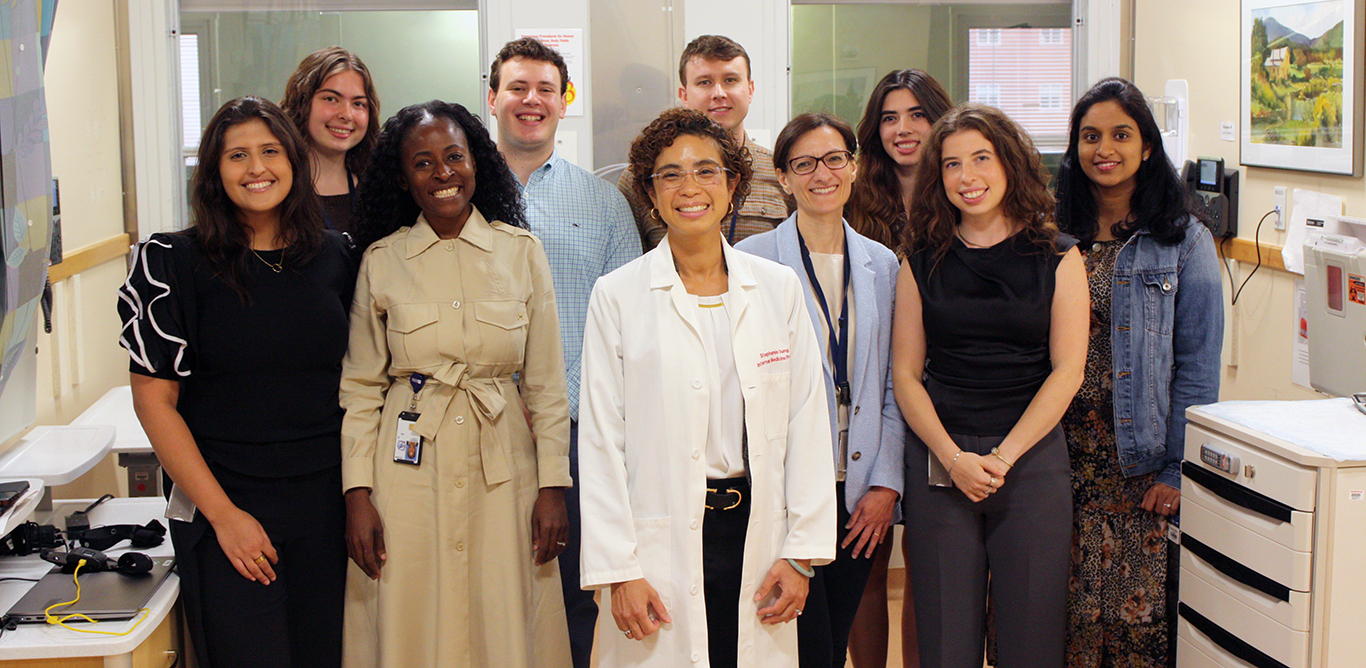
From left to right: (Front Row): Ila Kacker, Lilian Mabundo, Dr. Stephanie Chung, Noemi Malandrino, Natalie Macheret and Geethika Thota and (Back Row) Eleanor Flacke, Samson Cantor, Aaron Hengist and Madilyn Gaydos.
Dr. Stephanie Chung Works to Advance Treatment for Youth-Onset Type 2 Diabetes
One of the most important things that pediatricians like Dr. Stephanie Chung learn during their medical training is that kids aren’t just mini-adults. One of the clearest examples of this is type 2 diabetes, a disease that was once so vanishingly rare in young people that it was commonly referred to as ‘adult-onset’ diabetes. Sadly, that nickname has since become outdated. Type 2 diabetes now affects many more kids and young adults than it used to, often with more severe consequences than those seen in older patients.
“It’s not like the disease you see in your grandpa who gets type 2 diabetes when he’s 60 or 65 years old,” Dr. Chung explains. “Kids with type 2 diabetes, unfortunately, can quickly get very sick. We want to understand why it is that these kids are different — why they’re developing related medical problems so rapidly and why they are not responding to the typical medications.”
Type 2 diabetes occurs when cells start to become de-sensitized to the commands of a hormone called insulin, which instructs them to absorb sugar in the blood. The resulting high blood sugar can harm many of the body’s organs if it persists.
By some estimates, the number of people under the age of 20 newly diagnosed with type 2 diabetes doubled between 2002 and 2018. What’s more, those young patients tend to develop diabetes-related complications such as kidney and heart disease much more quickly than adults with the condition.
On top of that, the first-line treatment for the disease is also significantly less effective in young people than in older patients. That treatment, called metformin, is supposed to help lower blood sugar levels by reducing the amount of sugar made in the liver.
Unfortunately, it’s not enough to control the disease in about half of young people, requiring them to be put on another medication within two years of starting metformin. By contrast, most adult patients diagnosed with type 2 diabetes do well on metformin for up to a decade.
“When I first started to study metformin, so many people were asking me, ‘Why are you doing this? Everybody understands metformin,’” Dr. Chung recalls. “And I just kept thinking that if we understood it already, then why doesn’t it work well for so many young people?”
Contrary to the dominant theory about metformin, Dr. Chung’s research suggests that the medication may not really have much of an effect on the amount of sugar produced by the liver after all. Rather, metformin might lower blood sugar by shifting the population of microbes living in the intestines, known as the gut microbiome.
“It took looking at the disease in these kids to really understand the mechanisms and find out why that doctrine that we were taught in our textbooks wasn’t quite right,” Dr. Chung says. “Both our own studies and other research have come out recently supporting what some might call ‘off-target mechanisms’ for metformin — although I don’t like to use that phrase because I don’t know that we really understood what the target was in the first place.”
Based on her findings, Dr. Chung contends that many young people with type 2 diabetes should be treated with a combination of metformin and another drug called liraglutide, which can assist metformin with controlling patients’ blood sugar. Importantly, her research could help doctors figure out which patients will need more than metformin and which may not, an important consideration since additional medications often lead to additional side effects.
Having studied the livers and gastrointestinal tracts of kids with type 2 diabetes, Dr. Chung has now shifted her focus to their hearts. In adults, heart disease is usually linked with high levels of a form of cholesterol called LDL cholesterol, and many adults take statins to bring their LDL cholesterol levels down. However, Dr. Chung’s research suggests this relationship doesn’t hold up in young people with type 2 diabetes, who don’t typically have dangerously high levels of LDL cholesterol, but still often develop early signs of cardiovascular disease. To solve that mystery, her team is conducting the Young at Heart study, which explores the biological and social drivers of cardiovascular disease in young patients with type 2 diabetes. She sees patients enrolled in the study at both NIH and Children’s National Hospital in Washington, D.C.
“Because of the differences between type 2 diabetes in kids versus adults, it’s not sufficient to just take what we’re doing with the adults and do the same with the kids by starting them on these statins,” Dr. Chung says.
- Brandon Levy