



The Infectious Diseases Society of America hails Dr. Sameer Kadri for epidemiological research with global impact.
The Infectious Diseases Society of America hails Kadri for epidemiological research with global impact.
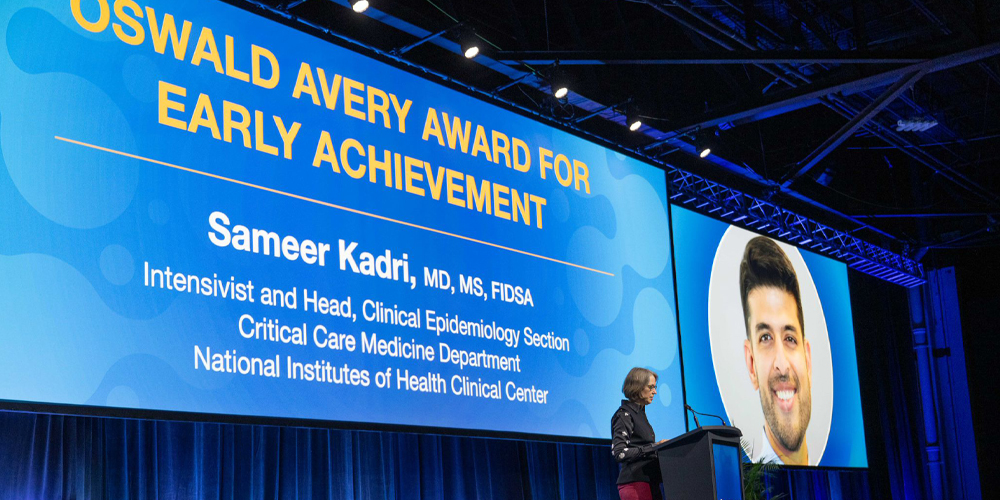
Dr. Sameer Kadri, an ICU doctor and data scientist with the NIH Clinical Center’s Critical Care Medicine Department (CCMD), has received the 2025 Oswald Avery Award for Early Achievement from the Infectious Diseases Society of America.
In making the announcement, IDSA hailed Kadri as a global leader in his use of data science to explore pressing questions about antimicrobial resistance, sepsis, the COVID-19 pandemic and other epidemiological challenges.
Kadri said he felt honored to receive the award and humbled to join past NIH winners Drs. Michail Lionakis, John I. Gallin and former CDC Director Rochelle Walensky. “I’m so grateful to my superstar team at the NIH and wonderful collaborators at the CDC, FDA, Harvard and beyond, who collectively enabled me to turn mountains of data into solutions for the sick and dying,” Kadri said in written acceptance remarks.
IDSA presented the Oswald Avery Award for Early Achievement during its 2025 IDWeek annual conference in Atlanta in October. Each year, the award recognizes an IDSA member or fellow for extraordinary achievements made before the age of 45.
Dr. Henry Masur, chief of the NIH Clinical Center’s Critical Care Medicine Department (CCMD), describes Kadri as a “creative force” and an outstanding clinician, investigator, mentor, colleague and entrepreneur.
Masur said Kadri was among the first investigators at NIH to introduce large data analysis to the Institute’s portfolio of basic and clinical translational research. “That really was his gift to NIH.” Masur praised Kadri’s use of large data sets to rapidly assess critical questions, and produce high-impact research that influences government agencies and professional societies.
One innovation developed by Kadri and his colleagues is the “Difficult-to-Treat Resistance” framework. The index measures the threat of antimicrobial-drug-resistant bacteria. Adopted by the World Health Organization, the index factors in regional availability of first-line treatment options in interpretation of the clinical impact of antibiotic resistance.
Currently a tenure track investigator and head of the Clinical Epidemiology Section of the CCMD, Kadri joined the NIH Clinical Center as a critical care fellow in 2010 and transitioned to staff clinician in 2014.
Kadri said he was shocked when several of his critically ill patients during his training years died from bacterial infections with no available effective antibiotics. “[It] seemed very counterintuitive compared to many other medical advances that were happening at the time,” Kadri recalled.
“It’s like, how do we not have antibiotics?” Kadri says this realization sparked his drive to work on the global crisis of antibiotic resistance and sepsis.
Kadri established collaborations with data companies, universities and several federal agencies to access and analyze large troves of patient data to advance insights into epidemiological questions.
The relationships were instrumental in rapidly gaining important epidemiologic insights during the pandemic, for which Kadri’s lab was awarded the 2024 NHLBI COVID-19 Response Award.
Today, Kadri’s multidisciplinary lab has grown to 18 full-time employees and contractors ranging from clinicians, pharmacists and microbiologists, to biostatisticians, epidemiologists, informaticists, and AI and policy experts. Kadri was also recently recognized with the Ruth Kirschtein NIH Director’s Award for mentoring excellence–a testament to his leadership and passion for helping nurture early careers for many at NIH.
Kadri said: “Data science is a fast-moving field. We are mission driven; I encourage continuous active group learning in the lab, which helps us stay ahead of the curve.” Many share overlapping skills and expertise, Kadri said, and, as a result, “We have people who challenge each other. That not only helps raise everybody’s knowledge bar, but also makes the most cutting-edge research possible,” he said.
Kadri said that despite the challenges of the past year, he is optimistic for his team and NIH colleagues. “I know that there is such a strong drive to continue to excel in science and to do good for the community and for humanity … it is going to carry us through.”
—Sean Markey