



How NCI, Clinical Center and Walter Reed staff collaborated on a marathon surgery to give a cancer patient hope
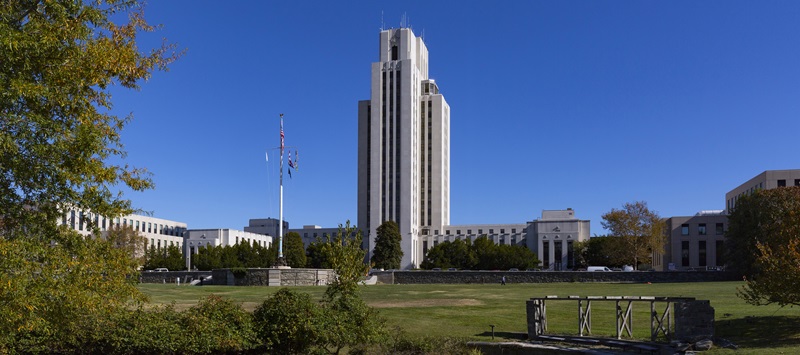
Walter Reed National Military Medical Center
Shortly after Alessandro Colombo was diagnosed with a rare form of urachal bladder cancer, the 48-year-old IT consultant began treatment in his native Italy.
But when his doctors learned that his tumor had turned metastatic, there was no standard treatment they could offer beyond chemotherapy.
So Colombo began an urgent search for more promising therapies to treat his cancer, which had spread to his lung and lymph nodes in his chest. He found a perfect match in a clinical research trial at the NIH Clinical Center led by Dr. Andrea B. Apolo of the National Cancer Institute (NCI).
A senior investigator in the Genitourinary Malignancies Branch of NCI’s Center for Cancer Research, Apolo is among the world’s foremost bladder cancer researchers and has led dozens of clinical trials of novel immunotherapy and targeted treatments. With the support of friends and family, Colombo moved to the U.S. and rented an apartment near the NIH campus so that he could enroll in the clinical trial.
After 12 months of treatment, the tumor in his lung and lymph nodes shrank 38 percent. “He was really doing well on the treatment,” Apolo said. “Except a few months later he developed new metastatic disease to the brain and maxillary sinus.”
Apolo consulted with Clinical Center neurosurgeon Dr. John Heiss to address the tumors in Colombo’s brain. Heiss who surgically removed one brain tumor, while radiation oncologist Dr. Huma Chaudhry treated the other.
However, the tumor on Colombo’s maxillary sinus proved the most challenging. “That was something that we hadn’t seen before,” Apolo said. “It’s a really rare cancer doing a rare thing.”
Apolo consulted Dr. Nyall London, an NCI otolaryngology surgeon-scientist with a dual appointment at Johns Hopkins Medical Center.
An expert in disorders and cancers of the nasal cavity, sinuses, and skull base, London told Apolo that removing the tumor on Colombo’s sinus would be very complicated.
“He could lose an eye and is going to lose half his mouth,” Apolo recalls London telling her. Moreover, a team of plastic surgeons and vascular microsurgeons would need to rebuild Colombo’s face. They would have to create a plate and graft tissue from Colombo’s body, stitching tiny blood vessels together under a microscope.
A major problem: The Clinical Center does not have plastic surgeons or vascular microsurgeons. But Apolo had an idea. The physician-scientist reached out to Dr. Paul Wistermayer, an otolaryngology head & neck microvascular surgeon and Dr. Ean Saberski, a plastic and reconstructive surgeon at Walter Reed National Military Medical Center located in Bethesda, MD., across from the NIH campus.
They right away said, “Absolutely—yes.’” Apolo recalled.
Drs. Wistermayer and Saberski offered to get credentialed and perform the surgery at NIH. They would bring their specialized equipment to the NIH Clinical Center and operate on Colombo there.
And so an elaborate choreography of coordination began between the two medical institutions. Walter Reed staff briefed NIH staff on how to prepare for what would be an intricate and painstaking surgery and recovery.
On one video conference call alone, there were 27 participants representing departments across the Clinical Center and NIH campus. “A lot of teams came together,” Apolo said. “It was kind of a beautiful thing to see.”
NIH Clinical Center nursing staff, for example, learned how to use special ultrasound techniques to monitor the microvasculature in Colombo’s reconstructed face in order to monitor it every hour to ensure the grafted tissue didn’t die.
By early September, the day of Colombo’s surgery had arrived. Starting at 8 a.m., surgical teams spent the next 12 hours removing the tumor in Colombo’s sinus and then meticulously reconstructing his face in the first phase of the effort.
The surgery was exhausting but ultimately successful. Colombo spent the next week in the ICU recovering, cared for by Clinical Center staff in consultation with medical teams from NIH and Walter Reed.
Colombo had three words to describe his team of specialists, “They are amazing.”
Speaking by phone from his U.S. home away from home with his sister Laura Colombo by his side, Alessandro said his experience at NIH “was an amazing discovery.”
He said the experimental treatment that he received for his cancer at NIH had granted him life he would not otherwise have, had he remained in Italy. But Colombo said there was more, noting the compassion, warmth, and determination to help he encountered.
“What we found is practically a new home and a beautiful one,” he said.
“It was really, really unbelievable,” Laura Colombo said. “We do not have words to express our feeling, our gratitude.”
Today, Colombo continues his treatment at the Clinical Center. “His care is now outpatient,” Apolo said. “He’s doing well, one day at a time.”
—By Sean Markey with additional reporting from Yvonne Hylton and Maria Maslennikov.