



How NIH and Clinical Center research powered the first FDA-approved treatment for alkaptonuria.
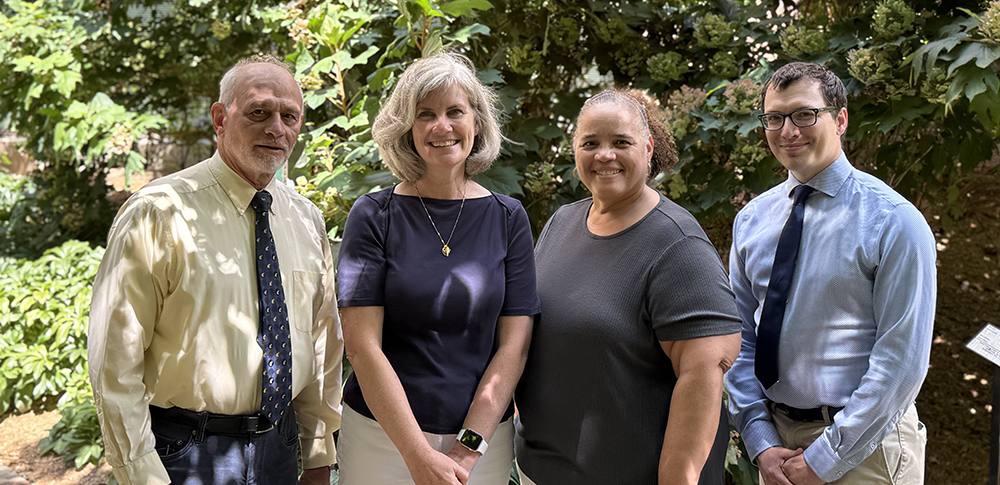 From left: Dr. William Gahl, Dr. Wendy Introne, Joy Bryant RN, Dr. Francis Rossignol. Not pictured: Dr. Monique Perry, Kevin O’Brien RN, Kate Spears.
Like mayors who plant trees so that future generations will have shade, the scientists who study rare diseases hope their research will lead to future treatments and cures.
In 1998, Dr. Wendy Introne was one of those early career physician-scientists. Fresh from pediatric residency at Children’s National Medical Center in Washington, D.C, Introne came to NIH for fellowship training in clinical and biochemical genetics.
Her boss was Dr. William Gahl, the renowned medical geneticist who studies rare and undiagnosed diseases at the NIH National Human Genome Research Institute and would later found the NIH Undiagnosed Diseases Program.
Seeking a research project, Introne asked Gahl about rare diseases she might study. He suggested alkaptonuria (AKU), a rare genetic disorder characterized by the body’s inability to break down homogentisic acid (HGA), a substance produced during protein metabolism.
Sometimes known as black urine or black bone disease, AKU leads to damaging accumulation of HGA in connective tissues and a condition called ochronosis. The latter is characterized by debilitating arthritis in the knees, hips, and spine, as well as kidney problems, heart valve issues, and other systemic complications.
Gahl said there was a potential treatment for AKU, but the drug—nitisinone—was being studied for a different condition and wasn’t yet available for AKU trials. (Derived from a compound found in the Australian bottle brush plant, the molecule was initially studied by Swedish researchers as a potential herbicide.)
“It looks very promising, but we need to learn more about the disease,” Introne recalls her mentor telling her. “We don’t know enough about the natural history.” Gahl added that there were several AKU patients who lived close to NIH whom she could meet. “Would you be interested?”
“That was all it took,” Introne recalls. “I was hooked.”
Introne soon partnered with Dr. Monique Perry of the NIH Clinical Center Department of Rehabilitation Medicine. Together, the two co-investigators launched a natural history study of AKU to decipher how the disease affected patients, the biomarkers that could guide treatment, and what might slow it down.
“We learned a lot,” Introne recalls. A pivotal moment came in 2005, when Introne and Perry launched a three-year clinical trial to study nitisinone’s effect on 40 AKU patients, conducting in-depth clinical evaluations and surveying patient reported outcomes. Urine samples showed that nitisinone decreased patients’ HGA levels by 95 percent, on average. Yet, overall, the trial results were disappointing. Researchers hoped to see improved hip mobility as a measure of clinical benefit and thus lay the groundwork for FDA approval.
Introne says the team was forced to take a step back and regroup. “We didn’t want to give up because biochemically it was so positive,” she recalls, noting that research established that HGA was the culprit molecule behind AKU. “If you can lower that, it has to be good for the patients.”
“The missing piece for us was trying to prove that there was clinical benefit by lowering this metabolite,” Introne says. Ultimately they found their breakthrough.
In 2024, Introne, Perry, Gahl and their fellow collaborators published a study in the journal Molecular Genetics and Metabolism that revisited the detailed patient reported outcomes survey data collected during their original 2005–09 clinical trial. Two team members, Dr. Francis Rossignol and Kate Spears, were particularly instrumental in scoring and analyzing the patient reported outcomes data.
In the 20 years since that trial began, scientific attitudes around the validity of patient reported outcome surveys had evolved. Today data from well-designed surveys is no longer considered subjective evidence. “We recognize that patients are pretty in tune with how they’re feeling,” Introne says. “So it’s become a much more acceptable outcomes measure.”
Analyzing their original patient survey data, the authors established that nitisinone “improved both the quality of life and function of patients with alkaptonuria” by improving pain, energy levels and physical functioning after three years of treatment.
Cycle Pharmaceuticals, a U.K.- and U.S.-based pharmaceutical company focused on rare metabolic and neurological genetic conditions, used the study to seek U.S. regulatory approval. In June 2025, the Food and Drug Administration approved nitisinone as its first approved treatment for AKU.
Introne and her colleagues are hopeful that administering nitisinone to AKU patients early in life can slow, if not prevent, the progression of the disease later in life. Related studies are now underway.
For AKU patients, the decades of research and resulting breakthrough has been transformative. “This will change my life,” says Aaron Snyder, a 44-year-old Army Corps of Engineers infrastructure banker from Floodwood, Minnesota. “It’s going to change the lives of everybody that has this disease.”
Synder, who had back surgery in his mid 30s, says the impacts of the disease were starting when he began taking nitisinone off-label seven years ago. “There’s been no progression since I’ve been on the drug,” he says. “Mentally, though, it’s been a game changer. I think it’s just given me much more hope for the future.”
Gahl, Introne’s collaborator and former mentor, says, “This long saga illustrates the importance of young investigators and persistence in advocating for individuals with unmet needs, such as those with rare diseases that have no approved treatment.”
-Sean Markey