



Content on this webpage is provided for historical information about the NIH Clinical Center. Content is not updated after the listed publication date and may include information about programs or activities that have since been discontinued.
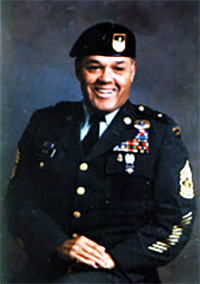
Guinness World Records in London has proclaimed Howard P. Drew Jr., a regular at the Department of Transfusion Medicine’s blood bank, the world’s most prolific blood donor.
Guinness recently selected his achievement for inclusion in the Medical Triumphs section of the 2003 Guinness World Record Book as the standing record for “most blood donated by a single person.”
Between 1950 and 2000, Drew donated a documented 213 units of blood — about 28 gallons — at the NIH Blood Bank and the American Red Cross in Washington, D.C. The vast majority of that amount, 170 units, was drawn at the blood bank in the Clinical Center.
Drew first made contact with the Guinness folks in 2000 when he wrote to them asking what the record was for blood donation. At that time, the record for “most plasmapheresis blood donations” was being monitored. Learning this Drew again wrote to Guinness in March 2001 requesting a claim for the most blood donated based on units, not platelets.
By summer 2001 Guinness, having received proof of Drew’s blood donation actions in the form of witness statements and documentation from the American Association of Blood Banks, certified him as holding the record for “most blood donated by a single person.”
Guinness receives 50,00 inquiries each year and uses stringent guidelines to certify records in new and existing categories. From the time of accepting the new record category of “most blood donated by a single person” two more claims were sent to Guinness. They knew how much blood Drew had donated but hadn’t received the proof and had to accept the following claims, the first of which only held the record for a day.
April 5, 2001 — Robert Hall, Christchurch, New Zealand, (177 blood unit donations) followed by April 7, 2001 — Arvind Kumar Agar, who donated his 195th blood unit at a blood bank in Indore, India on August 25, 2000. The latter held the record until July 24, 2001 when Drew set the current world record.
The process time for accepting a record can vary from a minute to days, weeks or months. “With more straightforward inquiries like ‘The Oldest Cat’ or ‘The Tallest Sunflower’ it is easy to check evidence against an existing record to see if it’s been broken.
But other records particularly if they are new, may take a bit longer,” said Della Howes, Senior Records Researcher and Television Research Manager for Guinness.
Howes emphasized some records may never be broken. “For example, one of our most famous record holders, whose record is yet to be beaten is Robert Wadlow, the tallest person ever for whom there is irrefutable evidence. He measured eight feet, eleven and one-tenth inches in height in 1940, shortly before his death. Even the chap whose height I measured last month, Hussein Rissad, is a long way off at seven feet, six and a half inches!” she said.
Of Drew’s most prolific blood donor status Howes reflected, “We at Guinness World records are delighted to acknowledge his achievement because it helps so many people and hopefully will encourage others to become donors if they are not already.”
Although he’s thrilled to hold the Guinness blood donor record, it is more important to Drew to be able to give his blood to help others.
“I think it’s a noble cause to give blood. Every time I donate, I get the only feeling that’s greater than the one you get when you receive the help you need, and that’s the feeling you get when you help others in need,” he said.
Just how much he helps becomes clearer when considering Red Cross estimates that a gallon of donated blood helps to save 24 to 32 lives. And as one interviewer wrote about him, “Drew, whose type O-positive blood makes him a universal donor, has probably saved enough people to populate a small town.”
A specific incident from Drew’s past plays a role in his motivation to donate blood. In 1945, after two years of combat duty as a member of the U.S. Army’s 333rd Artillery Battalion in World War II, he was traveling in an army bus in Massachusetts when the vehicle crashed into a tree and burst into flames. He escaped from the overturned vehicle and went back to rescue fellow soldiers trapped in the flaming wreckage. He saved several lives that day and was cited by the Army for his heroism but he also suffered severe bums on his hands and face. Blood donors came to his aid — something Drew always remembers.
“I give blood every two months. It’s simple, and it doesn’t hurt,” he said.
Retired from his roles as NLM reference librarian and U.S. Army Command Sergeant Major, Drew, 77, is a native of Hartford, Conn, and has lived in Washington since 1946.
He points out that in some ways his accomplishments parallel his father’s life. Howard Drew Sr. participated in the 1912 Olympic games in Stockholm and held the world record for the 100- and 220-yard dashes in 1914.
“That’s two generations of world records. I’m also proud that my dad and I each accomplished ‘firsts’ as African Americans,” he said referring to the fact that his father became the first black judge in the state of Connecticut and to his own blood donor record.
According to Guinness’ Howes, the 2003 edition of the Guinness World Record Book with Drew’s record for “most blood donated by a single person” in the Medical Triumphs section should be off to the printers in July and available by September.
In the meantime. Drew will be rolling up his sleeve for the next blood donation adding to his donor record and saving lives.
—by Dianne Needham