



Content on this webpage is provided for historical information about the NIH Clinical Center. Content is not updated after the listed publication date and may include information about programs or activities that have since been discontinued.
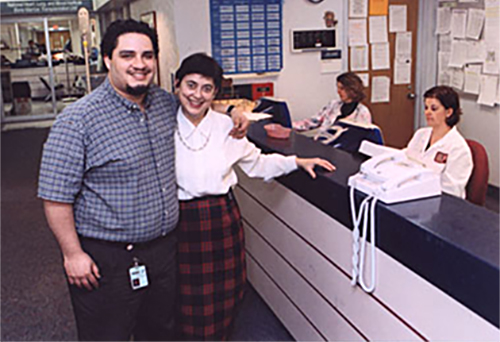
The Clinical Center has responded to its international patient population by hiring two multilingual interpreters, a first in Clinical Center history.
“We’re like cultural brokers,” said Jose Rosado-Santiago, one of the newly hired interpreters. “The patient comes here and is unfamiliar with how NIH and the Clinical Center work and the staff is unfamiliar with how things work for the patient. It’s not that the patient doesn’t speak English, but it’s that the staff doesn’t understand the language and the culture. It works both ways.”
Rosado-Santiago came to the Clinical Center as an intern through the Hispanic Association of Colleges and Universities. Being fluent in English, Spanish, French, Italian and Creole, Rosado-Santiago volunteered his services as an interpreter at the Clinical Center before applying for the new position.
“It’s more rewarding to be a part of the process and watch these patients come to the Clinical Center not knowing where to go or what to do, and in a matter of weeks, they can find their way around and go to the market by themselves,” he said. “It’s just good to know that you were a part of that process of a patient becoming independent.”
When Maria Rudulovic’s husband told her about interpreters being needed in the Clinical Center, she came to volunteer and was put to work immediately. That was in July 2001. Five months later she was hired permanently.
“NIH is a model and strives to be the best at what it does,” said Rudulovic, who is fluent in Spanish, English, French, and German. “We are striving to be the best model for international patients.”
The move to hire two full-time interpreters stems from a federal executive order passed in August 2000, requiring all federal facilities receiving medical funding to provide adequate service to those with limited English proficiency. Those agencies not providing adequate service are in violation of Title VI of the Civil Rights Act of 1964, that promises equal access to all federally assisted programs and activities.
According to the Office for Civil Rights, English is spoken by 95 percent of the people in the United States. However, the remaining five percent represent millions of people who cannot speak, read, write or understand English.
“Patients are being brought in from different countries and we are required to provide good, quality patient care, and that includes interpreters,” said Andrea Rander, director of Volunteer Services.
Within the past three years, the demand for interpreters has grown six times, exceeding the capacity of the original program. The interpreter program began as a volunteer-only program.
In 1990, only two volunteer interpreters who spoke Spanish were needed. Today, the numbers have grown to more than 100 volunteers and 42 languages.
Yet oftentimes volunteers are not always available. When interpreters are not provided, then service to patients may be delayed or sometimes denied until an interpreter can be found.
According to Adrienne Farrar, chief, Social Work Department, that is not how the Clinical Center should present itself to its international patients. In fact, Farrar sees these new hires as just the beginning of a much larger program. “We are continuously building the program,” she said.
“We are establishing policies and procedures and we are piloting several new systems.”
One new system is the CyraPhone, which is currently in use. The phone is a dual-handset tele- phone that allows a patient and a physician to be on the line at the same time while speaking to an interpreter. The interpreter on the other line is part of the Language Line, a service providing interpreters on- demand. The service has translators in 142 languages.
Farrar also hopes to incorporate employee training and education into the program. Many employees don’t speak a second language and are also unaware of cultural differences, which can hinder a relationship with a patient.
“We’d like to see more bilingual employees on staff,” said Farrar. “If a nurse is hired and speaks two or three languages, that nurse should be compensated for providing a service.”
Overall, Farrar said she would like to see the Clinical Center provide more than just an interpreter to it’s international patients.
“I see this developing into an international patient center that can follow patients from recruitment through discharge,” said Farrar. “We want the Clinical Center to be seen as an international resource and we want to have services that support those resources in order to make our international patients feel comfortable and adjust to life not only in the Clinical Center, but also in this country.”
-by Tanya Brown