



Content on this webpage is provided for historical information about the NIH Clinical Center. Content is not updated after the listed publication date and may include information about programs or activities that have since been discontinued.
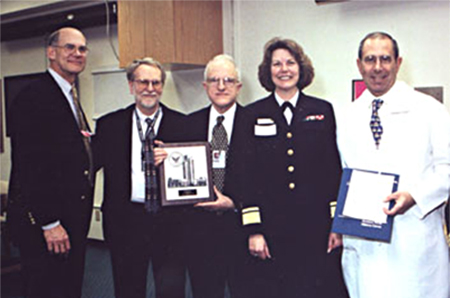
The Clinical Center Department of Laboratory Medicine’s Microbiology Service has received special recognition for its response to the anthrax crisis in October when Washington, D.C. postal workers and Capitol Hill staff were victimized by a bioterrism assault. The Microbiology Service team analyzed nearly 700 nasal swab specimens that came from workers on Capitol Hill, and another 3,200 from staff at the Brentwood Post Office and other buildings.
A letter of appreciation signed and delivered to the Clinical Center by Rear Adm. Kathleen Martin, commander, National Naval Medical Center praised Laboratory Medicine’s assistance during the occurrence. The letter, addressed to Clinical Center Director Dr. John Gallin, praises the laboratory staff’s “impeccable technical ability” and willingness to take on “a disproportionate amount of samples” for analysis.
“Since 11 September 2001, our Nation has responded to the call of freedom many times, on many fronts,” Martin noted in the letter. “Among those were the bioterrorism attacks on Capitol Hill. Within hours of notification of the attack, the federal treatment facilities within the National Capitol Area became involved in one of the largest clinical efforts ever undertaken to process bioterrorism material.”
On Nov. 7, Senate Majority Leader Tom Daschle visited the National Naval Medical Center to thank Martin and staff members from the institutions that participated in specimen processing and analysis for their assistance during the anthrax attack.
“Laboratories like these are the front lines in the battle against bioterrorism,” he said. He later presented Martin with the U.S. flag that was displayed over the Capitol on the day of the attack. The same flag was raised at the main entrance of the NNMC across the street from the NIH campus.
“When we talk about our laboratory services,” Martin said at the Clinical Center ceremony, “you are the people who are always behind the scenes. And when we talk about bioterrorism, you really are on the front lines. You’re the experts—the ones who make the calls. And I’d like to thank you for being on the front lines with us.”
Responding to Martin, Dr. Gallin thanked his team for its responsiveness. “It’s nice to see these folks stepping forward and showing their dedication,” he said.
Accepting the letter on behalf of the Microbiology Service was Dr. Steven Fischer, a medical officer and one of the senior staff. “Anthrax has been a major concern for the healthcare community for years,” he said, “but it’s all been theoretical. We all knew we should be thinking of ways to respond, but until you have an incident, it’s very difficult to say how it would be coordinated.”
Dr. Frank G. Witebsky, acting chief of the service at the time, agrees, noting that the computer system isn’t designed to take many specimens from outside NIH. He credits Jeanne C. Preuss, the supervisor in the Virology Section as responsible for solving the computer problem. After receiving the initial call from the Naval Medical Center, senior management quickly determined to support the effort. Service staff established a matching station at which specimens were matched with a hand-written log, a labeling station and a processing station. After the initial set of specimens was received, Chief Technologist Laura Ediger developed a list of volunteers who could work if needed at off hours.
All technologists who were not handling the samples being screened for anthrax covered the regular work that ordinarily would have been dealt with by those working on the anthrax samples. Dr. Vee J. Gill, along with supervisor Caroline Dorworth Fukuda and technologist Alexandra Wong, screened all the cultures for suspicious organisms.
Of a total 3,929 swabs that were analyzed, only six raised suspicions.
They were then sent to the Armed Forces Institute of Pathology for further evaluation, one of only a few labs in the country that conducts more definitive testing.
“It was incredible to watch the technologists,” Witebsky said. “Each was pulled from something else he or she was working on and the teamwork was amazing.”
Complicating matters was the suddenly high level of operational security adopted throughout the federal government.
“Security was very high, so it wouldn’t do to have a cab driver show up with anthrax samples,” Witebsky said. “Some NIH Security members made runs downtown to get the specimens. Meanwhile, NNMC provided us with 1,500 specimen plates. No one had dealt with a situation like this before.”
“You could see the concern on the faces of the Security personnel delivering the specimens,” said Ediger. “It was very somber.”