



Content on this webpage is provided for historical information about the NIH Clinical Center. Content is not updated after the listed publication date and may include information about programs or activities that have since been discontinued.
Nurses and Pharmacists Bring Comfort in the Midst if Deadly Fear
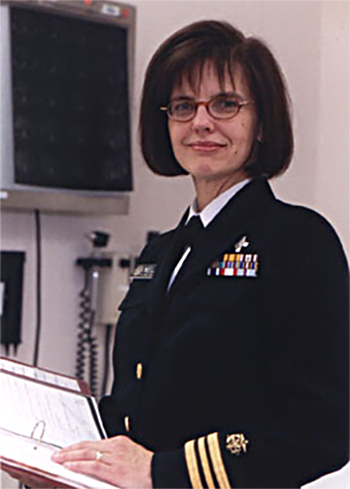
Lt. Cmdr. Lucienne Nelson and her colleagues face the realities of anthrax. They aren’t wearing contamination suits and testing for spore traces in legislative buildings and post offices, but they are calming nerves, wiping tears and comforting the thousands of people affected by the deadly bacteria.
A group of 27 Clinical Center nurses and pharmacists were deployed to the Washington, D.C. area, to educate and test postal workers and congressional staff, and dispense antibiotics to anyone who may have come in contact with the anthrax spores.
“It’s what I train for,” said Lt. Cmdr. Nelson, RN, research nurse, Pediatric Oncology Branch. “We just came to try and help.”
Nelson was called to the Hart Senate office building two days after returning from New York City, where she was among the 43 people on the Commissioned Corps Readiness Force, an immediate response tea sent to Ground Zero to assist rescue workers. “It was like being in a foreign country looking at ancient ruins.
All you could do is stare in total disbelief,” said Nelson. “I needed those two days just to regroup and get my bearings.”
At the Hart Senate office building, Nelson helped set up a treatment area for Capital Hill employees from Senator Tom Daschle’s (D-South Dakota) office, where one of several anthrax-laced letters was mailed.
Nelson worked two 17-hour days taking nasal swabs and educating employees about the nature of anthrax before being sent to the main Capital building.
“Most people were more concerned about whether or not they were going to bring this home to their kids,” said Nelson. “We were trained in infectious diseases, so we knew that you couldn’t get the disease from casual contact, however, we had to ease the minds of these individuals. They were concerned for their lives and for their families lives.”

Anthrax is an illness caused by bacteria called bacillus anthracis. The bacteria can form a protective coat around themselves called spores. When actively multiplying, the bacteria release poisonous substances into the bodies of infected people.
According to the Centers for Disease Control and Prevention (CDC), anthrax is not easily transferable. An infected person cannot pass the dis- ease on by coughing or touching another person. The skin form, or cutaneous anthrax, can only be harmful if the bacteria enter through a cut in the skin. A sore develops and in a few days turns into a blister with a black scab in the center.
Skin anthrax is more easily treated than inhalation anthrax. Inhalation anthrax is the most serious form of the disease and is caused by inhaling the anthrax spores. The spores begin to nest in the lymph nodes where the bacteria multiply, creating toxins. The body responds to the toxins by creating flu-like symptoms. The increase in toxins is what eventually causes death.
“This is what gets people confused. They come in to the hospital and tests are negative, so they think they have the flu. However a couple of days later, when the toxins begin to take over the body, the individual thinks that it couldn’t be anthrax because the initial test was negative,” said Nelson. “By then, unfortunately, the person may die and the problem wasn’t that they had a bad doctor or that they went to a poor hospital, it’s just the nature of the organism.”
It’s that nature that sent thousands of postal workers and others who work in the Washington, D.C. area to D.C. General Hospital to be tested and receive antibiotics. The hospital, which was downsized and taken over by a private company earlier this year, reopened portions of the building to handle the barrage of people.
“There were some angry people,” said Lt. Felicia Andrews, RN, unit coordinator on 13 West. “They were afraid and would come into the hospital and have panic attacks because they were so upset.”
Andrews spent two days at D.C. General Hospital and saw nearly 2,000 people each day. The first two days that the hospital was open, nasal swabs were taken from each individual. Afterwards, no swabs were taken, but most individuals were given a 10-day supply of antibiotics.
“People were under the impression that they were going to be swabbed, because they thought it would determine if they had anthrax,” said Andrews. “When we told them that we weren’t doing anymore swabs, and the person knew that their buddy was swabbed the day before, they became upset and wondered why they couldn’t be swabbed.”
Since there is no type of screening for anthrax, no test exists to determine if an individual has been exposed to the bacteria. Based on a CDC report, the only way exposure can be determined is through a public health investigation. Nasal swabs and environmental tests are done to determine the extent of exposure in a given building or workplace, not to determine whether an individual should be treated. Even the use of a home test kit cannot determine if a person has been infected with the bacteria, but rather is a device to test environmental samples.
By the second day, workers at D.C. General Hospital had swabbed enough people to determine what areas in Greater Washington were of high risk.
“We were answering questions and dispensing antibiotics to anyone who walked in the door,” said Lt. Cmdr. Katherine Berkhousen, RN, BSN, clinical research nurse, HIV/AIDS Outpatient Research Clinic.
Postal officials were bringing employees by the busload, while concerned citizens lined up to receive antibiotics.
“Their main concern was that they wanted to be treated,” said Lt. Cmdr. Scott Dallas, senior staff pharmacist. “We had exactly what they needed, but we wanted to make sure that they got the maximum benefit from it.”
Dallas evaluated individuals and then dispensed Ciprofloxacin or Doxycycline, two antibiotics used to fight the anthrax bacteria.
Berkhousen spoke with people one-on-one to ease their concerns, and in some cases made phone calls to parents and guardians of employees with disabilities and special needs. “We didn’t turn anyone away. Our main concern was dispensing antibiotics to people not at risk. We didn’t want to say no and turn them away, because we really did not know.”
New information about the infected letters, and a continuous stream of buildings that tested positive for the bacteria was constantly changing. With no bathroom breaks and shortened lunch breaks, Berkhousen said it was like being cut off from the world. “When you are seeing 2,000 patients a day it’s hard to keep up with what is happening. When the patients came in they were almost more up-to-date and educated than we were.”
Despite the never-ending workdays, just to be able to help is reward enough. “I was on a mission and I was going to do whatever it took to accomplish that mission,” said Nelson. “If all I get is a couple of hours of sleep each day, then I appreciate it. I’m just honored to be able to do my job.”
-by Tanya Brown