



Content on this webpage is provided for historical information about the NIH Clinical Center. Content is not updated after the listed publication date and may include information about programs or activities that have since been discontinued.
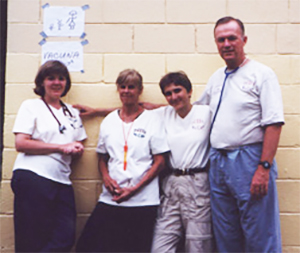
A team of Clinical Center employees are looking for a “few good colleagues” to join them in a life-changing experience. But be warned, this rewarding adventure won’t be easy.
Five Clinical Center staff took leave in July and paid their way to the Dominican Republic, where they had an opportunity to bathe in a bucket, sleep one night on a concrete floor and, if it weren’t for the local villagers, face the prospect of eating LifeSavers for dinner.
It was an experience they won’t forget. Not because of the poor living conditions, but because they helped to treat more than 600 people in need of medical attention.
“It’s not an easy week because you are totally out of your comfort zone,” said Dr. John Hurley, director, Pediatric Outpatient Clinic. “You have to adjust to a whole new way of life, but it is definitely an enriching and humbling experience.”
Dr. Hurley has been with the mission since its inception three years ago when he and members of his church, St. Raphael’s in Rockville, decided to support their sister church in the Dominican Republic with more than monetary donations. Their solution: provide medical care to the impoverished towns and villages of their sister parish.
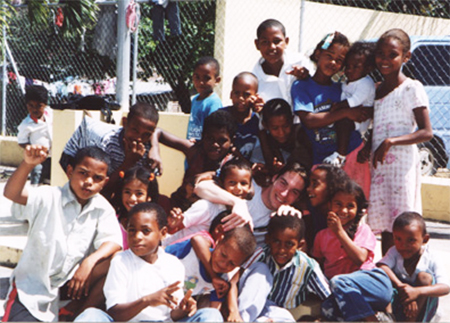
“We wanted to reach out and offer help as a way of building trust with the people,” said Dr. Hurley. “Providing health care was a way of demonstrating our good faith.”
St. Raphael’s provided the medications and other medical supplies.
It was Dr. Hurley who rounded up the Clinical Center team of Ellen Vaughan, dialysis nurse, Clinical Center, and Elaine Ruiz, pediatric nurse practitioner, Clinical Center. Dr. Bibi Bielekova, neurologist, NINDS, and a veteran missioner, recruited Dr. Kenneth Fischbeck, NINDS, to join the NIH contingent. The entire team was made up of 30 medical professionals, support people and interpreters from around the country.
On the first day of the mission, the group traveled from the small village of Guayabal, where they were lodging, to the even smaller village of Las Canitas. The two and a half-hour trip took them over rocky roads and up a narrow mountainous path where “we were literally hanging onto the back of an open-bed truck to stay inside,” said Dr. Hurley.
But what started out as a daylong trip would last even longer than expected.
The weather in July consistently brings rain during the day, but the group was able to reach the village dry. When they arrived, there were nearly 100 natives waiting for them to go to work. The office was a small building with no exam tables, lab or medical resources, other than what they brought.
“You have nothing to use but your hands and your head to best figure out what the problem could be,” said Dr. Hurley. “It’s a different experience to examine a child on the floor.”
Patients were treated that day beginning at 10 am and ending at 5 pm. The group packed up their supplies and prepared to head down the mountain, when they were informed that the afternoon rain had washed out the roadway. With no change of clothes, no food, other than a few packages of LifeSavers, and only a concrete floor for a bed, morale began to dwindle.
“I guess the people we treated got word that we were unable to return to Guayabal, because they brought us hot rice and beans and rolled up the mattresses from their beds and gave them to us,” said Ruiz. “These people had absolutely nothing, and yet they shared what they had.”
The next afternoon, following another day of treating the people of Las Canitas, the group was able to return to Guayabal and continue their mission work there and in the sur- rounding areas. They even dedicated one day to immunizing more than 300 children against H.flu bacteria, a common and often fatal cause of meningitis in infants.
“It was an overwhelming experience. The people are so needy, yet so grateful,” said Vaughan. “I thought the children would be begging us for money and candy, but instead they asked us for toothbrushes.”
The group left medicines with local organizers to be distributed when needed. Hypertension, heart attacks and strokes were among the major medical problems encountered.
“This whole experience just put things into perspective,” said Ruiz. “Out there, we worked together under poor circumstances, and we bonded together to get things done. It helps now when we are working and we have a stressful situation on the job to know that things really aren’t that bad.”
-by Tanya Brown