



Content on this webpage is provided for historical information about the NIH Clinical Center. Content is not updated after the listed publication date and may include information about programs or activities that have since been discontinued.
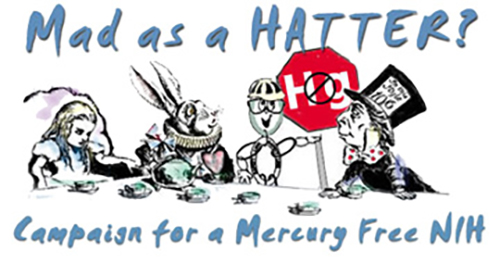
It’s time to retire and recycle those mercury-filled thermometers and blood pressure cups because the Division of Safety (DS) is “mad as a hatter” about mercury, and with your help they hope to eliminate it from the NIH.
The “Mad as a Hatter? Campaign for a Mercury-Free NIH” will kick off April 26 in Bldg. 10, in conjunction with Earth Day and Take Your Child to Work Day. There will be handouts, booths and presentations to help employees, their families and the community understand the hazardous effects of mercury in the workplace, homes, schools and the environment.
The kick off begins phase-two of the mercury reduction program, a NIH-wide initiative to dispose of all uses of mercury-containing devices, including non-medical devices in laboratories and electrical equipment.
The initial phase began in 1996, when the Clinical Center took steps to eliminate all unnecessary uses of mercury in medical devices and laboratory chemicals. Nearly 1,500 mercury-containing devices were removed, and today the CC is virtually mercury free. “We hope to build on the success of the Clinical Center campaign,” said Capt. Ed Rau, environmental health director, Division of Safety, Office of Research Services (ORS).
Mercury spills from broken thermometers are the most common hazardous material response incident in NIH facilities, according to a report from the ORS. Such spills can contaminate air to hazardous levels and require special equipment and decontamination by the NIH fire department.
“Some people think mercury is perfectly harmless to work with because they played with it as a child,” said Karen Heifer, information officer, DS.
Heifer said mercury is a curious material, and children would often find it and play with it.
“We want those people to overcome their prior belief that mercury isn’t dangerous.”
The campaign not only covers mercury-containing devices in laboratories, but will also concentrate on removing mercury in electrical equipment such as thermostats, switches, fluorescent light bulbs and batteries that contain small amounts of mercury.
“For most uses of mercury, there are substitutes, and use of these alternatives is encouraged” said Rau. “A little bit of mercury is a lot. We don’t have much left here, but we want to try and keep it as low as possible.”
For the few uses for which there is no substitute, mercury can still be used with appropriate safety precautions. All mercury waste must be segregated and carefully labeled in order to be recycled efficiently.
The voluntary campaign requires participants to sign a pledge to survey their work areas for items containing mercury, dispose of them properly, and replace them with mercury-free alternatives. A drawing for prizes will be held for all pledges that are submitted.
For more information or to submit a pledge electronically, visit the website at www.nih.gov/od/ors/ds/nomercury.