



Content on this webpage is provided for historical information about the NIH Clinical Center. Content is not updated after the listed publication date and may include information about programs or activities that have since been discontinued.
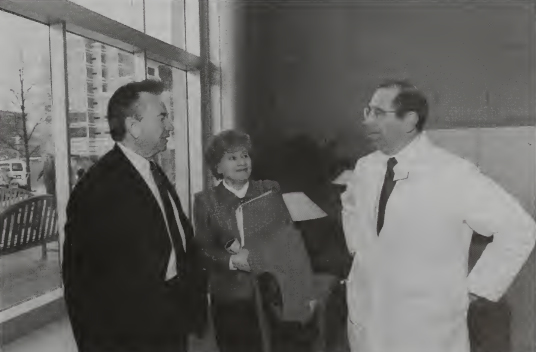
Newly appointed Health and Human Services Secretary Tommy G. Thompson visited the Clinical Center last month and toured various institutes prior to a press conference held on campus where he expressed satisfaction with NIH’s research efforts.
“This is truly a place where the future is made a better future for all Americans and the whole world through long-term investments and a lot of hard work from some very courageous scientists,” said Thompson. “President Bush and I certainly understand the importance of these institutes. We know that the work done here and the results achieved here represent one of America’s biggest contributions as nation.”
The former Wisconsin governor said he has been passionate about research for a long time, and that the president’s proposed $2.75 billion budget increase, the largest one-year increase in the history of NIH, will support the highest level of research projects and grants that will be given to hospitals and scientists all over the country.
“I asked the question, are you sure you will be able to use this money effectively? They said, without a doubt,” said Thompson.
Nearly 80 percent of the proposed increase is allocated as grant money to support research hospitals and institutions throughout the country. Only 25 percent of the grant applications submitted to NIH last year were funded.
As part of his first 100 days in office, Thompson has toured the country giving press conferences and campaigning to raise awareness of organ donation, a problem he sees as being remedied by citizens signing a donor card.
“We have 6,100 Americans who lose their lives each year because of lack of organs and it’s just not right in this great country of ours to have that kind of a problem,” he said.
Other problems he hopes to tackle while in office include retention and recruiting of medical professionals within NIH.