



Content on this webpage is provided for historical information about the NIH Clinical Center. Content is not updated after the listed publication date and may include information about programs or activities that have since been discontinued.
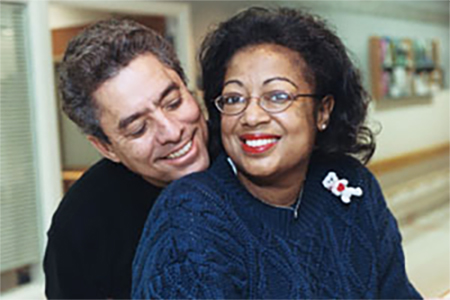
Acts of kindness, big and small, occur in unexpected places. Such was the experience for Karen Wilson of San Antonio.
She and David Carter had been working in the same office for five years at their jobs as computer specialists when Karen began feeling ill. Carter had noticed Wilson wasn’t her usual zestful self. Their relationship was like that of many coworkers, chatting about family and business matters or having lunch together, going home their separate ways at day’s end.
But Carter became concerned about Wilson and sent an email to her husband Bennie who confirmed his wife was having health problems— he told Carter she was experiencing kidney failure and needed a transplant.
Not long after he sent the email, Carter handed his coworker a note asking her to wait until she got home to open it. In that note, the essence of his message was a living donor’s plea, “please let me do this for you.”
Wilson couldn’t believe what Carter was offering. He was offering to give her one of his kidneys. “David is a warm and sensitive person. Neither of us is shy but we are private people so I was surprised,” she said.
Annually, living donors account for about one-third of the kidney transplants performed in the United States. Blood relatives, who offer the best chance of compatible tissues and blood types, are responsible for most of those donations. The United Network for Organ Sharing reports that unrelated donors were responsible for about 950 of the 4,000 living donor kidney transplants that occurred during January-September 2001 .
Several of her family members had already offered to be kidney donors but were not suitable matches. Carter was evaluated for his compatibility and discovered he was a match.
That was more than a year ago.
By early 2002 both Wilson and Carter were on patient care 11 East with the actual transplant set for Jan. 8. The procedure went well. Wilson, who is the third of four siblings, now refers to Carter as “her youngest brother.”
Doctors think a rare virus may have caused her kidney failure. Wilson is participating in an NIDDK clinical trial that is testing a new treatment protocol designed to reduce the need for anti-rejection drugs among transplant recipients.
She and her husband think coming to the NIH Clinical Center was a good idea.
“This was absolutely the right thing to do. We feel like Karen is doing her part for future medical scientific protocols. She and David are part of a building process. He gave his kidney to her and she is giving of herself by participating in the medical research process to in turn help the next person. Our only wish is that this chance were more universally available and economically accessible,” said Bennie Wilson.
After a brief recuperation, Carter is back on the job at Wilford Hall Medical Center in San Antonio. Wilson hopes to return to work there by late February. In the meantime she feels better about her present quality of life compared to before the transplant when she had to undergo dialysis four hours a day, three times a week and had difficulty climbing stairs.
She will also have the time to reflect on the generosity of her coworker. Perhaps Wilson’s mother, Eula Paul, summarized it best.
“It’s amazing when you think of who you haven’t known and then realize that someone reached out like that — an angel in disguise.”
Indeed.
-by Dianne Needham