



Content on this webpage is provided for historical information about the NIH Clinical Center. Content is not updated after the listed publication date and may include information about programs or activities that have since been discontinued.
Clinical Center Tightens the Reins of Security in the Wake of Terrorist Attacks
The first sign of heightened security at NIH in the wake of the Sept. 11 terrorist attacks on the World Trade Center in New York and the Pentagon in Washington, D.C. is gridlock along Old Georgetown Road and Rockville Pike.
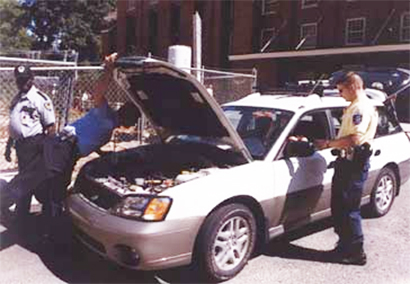
NIH police officers, in an effort to secure the campus, inspect each car for a parking permit and question those without a parking permit, prior to entering the campus.
Three entrances-Wilson Drive at Rockville Pike, Lincoln Drive at Old Georgetown Rd, and Center Drive at Rockville Pike-have been established as employee-only entrances from 6 am until 7 pm. The entrances are closed and blocked off after 7 pm. Center Drive at Old Georgetown Road and South Drive at Rockville Pike, are designated as the employee, visitor and delivery entrances. After 7 pm, these entrances are the only way onto the campus.
“We are doing our best to protect the campus based on our resources,” said Robert Fuller, deputy chief, NIH Police. “It’s nearly impossible to monitor pedestrian traffic on an open campus, so we are focusing on where we can give the greatest amount of protection.”
According to Fuller, vehicles without an NIH parking permit are inspected for exploding devices before entering the campus.
Officers check the trunk and under the hood and use mirrors to inspect underneath the car. Routinely, bomb-sniffing dogs are brought in to check larger vehicles. Those same vehicles, if being parked in the P3 patient parking garage, are inspected a second time before entering the garage.
“It’s a necessary evil,” said Lucy Adjei, Clinical Center. “It can be a bit over- whelming, but I think that the heightened security is good, and the people are doing a good job.”
Security stations have been set up at the South entrance of the Clinical Center with several police officers and security guards lined up in front of the door checking identifications and issuing color-coded visitor passes.
NIH security advisors have surveyed the campus and have advised officials on how to improve and change the overall security effort. “NIH is taking significant and calculated measures to protect employees and property,” said Billy Alford, OD/ORS.
Since the Sept. 11 attacks, all 51 NIH officers have been divided into two groups, working 12-hour shifts, seven days a week, to provide 24-hour protection on the campus.
Emergency phone calls have more than tripled with 1,000 extra calls coming into the department a week.
Many are calls of suspicious-looking people or unidentified packages. All annual leave for the department has been cancelled, according to Fuller.
“Morale has been very good under the circumstances,” said Fuller. “We have collectively come together to accomplish a goal and to make sure that things are safe and protected around the campus.”
“I totally understand the added security, but it’s a pain,” said Siu Ping, RN, BSN. “It takes an extra half hour just to get onto the campus.”
Herbert Hollins, HFCD, said that he approves of the protective measures, but “It’s a hassle and I don’t care much for it,” said Holhns. “I’m somewhat glad to see the added security, but it’s just a little too much.”
Despite the inconvenience, most employees have been cooperative and helpful. “Employees have been excellent. They want to feel safe, and we want them to feel safe,” said Officer Paul Mitchell. “People are safer on this campus then they are in their own neighborhoods.”
Do your part to keep NIH safe
- Always wear your NIH identification badge while on campus
- Challenge those not wearing their NIH badge or a visitor tag
- Should anyone see anything abnormal call the NIH Police non-emergency line at 301-496-5685
- Call 911 for emergencies