



Content on this webpage is provided for historical information about the NIH Clinical Center. Content is not updated after the listed publication date and may include information about programs or activities that have since been discontinued.
Youths Learn of Opportunities in Biomedical Research
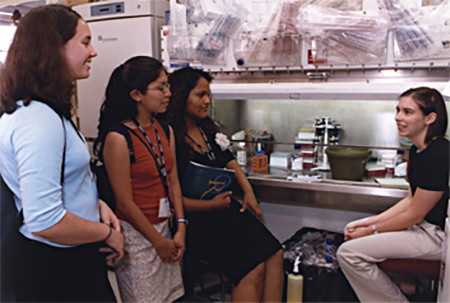
A half-hour talk on diabetes presented by Dr. Sanford Garfield, senior advisor, NIDDK, peaked Justin Norris’s attention. Most of his family suffers from the disease, which is one of the most serious health challenges facing Native-American Indians.
“I want to learn more about diabetes and research other ways to prevent the disease so that I can go back to the community and help my tribe,” said Norris, a member of the Gila River Pima tribe in Gila River, AZ.
But ask any of the 60 high school students why they came to the Clinical Center as part of the National Native-American Youth Initiative, designed to bring Native American Indians into the field of biomedical research, the answers are all the same-to give back to their people.
“We have an obligation to give back to our communities,” said Erin Tansey, an intern with NHGRI and member of the Navajo tribe. Tansey, a native of New Mexico, was one of two interns who spoke to the students as part of a panel. “All throughout New Mexico and especially on reservations, there is an extremely underserved population of American Indians. So we are all privileged to have a positive experience like this that will help us accomplish our goals.”
The program, sponsored by the Association of American Indian Physicians, began four years ago in an effort to motivate Native American students to remain in academics and pursue a career in the health profession or biomedical research.
Nearly 60 students from across the U.S. participated in the weeklong program that also included tours through the Library of Medicine, Uniformed Services University of Health Sciences, and U.S. Capital. The students spent one day touring the Clinical Center and listening to presentations on the Human Genome Project and research training opportunities at NIH.
“Many of these kids are from disadvantaged backgrounds and had the opportunity to either succeed academically or fail,” said Lancer Stephens, program coordinator for the National Native-American Youth Initiative. “But they chose academics because they care about their families and improving the lives of their people.”
Marlon Footracer lives in a community where going to college is unheard of. A member of the Navajo tribe from Page, AZ, he was accepted into five universities and will attend Stanford University in the fall. Footracer came to NTH through the NINDS summer internship program after participating in the youth initiative last year.
“I’ve always been encouraged by my parents and members of the community to pursue intellectual interests,” said Footracer. “I’m discouraged by the lack of healthcare and the health disparities in my community, and now I am motivated and have the opportunity to fix it.”
Of the 1,000 students interning at NIH this summer, fewer than 10 are Native-American Indians, according to Levon Parker, minority and special concerns program officer, NINDS.
Fewer than 70 applications were submitted by Native-American Indians, which is far below the number of applications for African Americans, Hispanics and people with disabilities.
“The only careers that some of these young people are exposed to are those they see in the communities and local high schools. Their role models are not research oriented,” said Frank GrayShield, MPH, public health advisor, NHLBI. “It’s important that these young people have a vision for the future, and with that vision they are able to make their lives worthwhile and to have made a difference not only to the people in their tribes, but to everyone.”
-by Tanya Brown