



Content on this webpage is provided for historical information about the NIH Clinical Center. Content is not updated after the listed publication date and may include information about programs or activities that have since been discontinued.
Demand for Language Interpreters Increases in Clinical Center
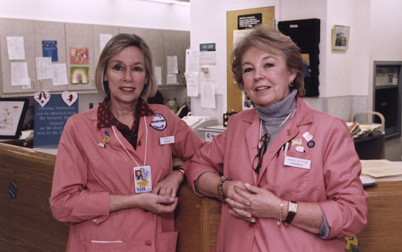
With many patients traveling to the Clinical Center from foreign countries, the need for interpreters has grown significantly over the past 10 years.
In 1990, there were only two volunteer interpreters who spoke Spanish, and the Office of Volunteer Services received one call a week for an interpreter. Today, the numbers have grown to over 100 volunteer interpreters and 42 different languages. Yet, it is still difficult to meet the demands of the patients.
“We are facing a lot of challenges. Patients are being brought in from different countries, and we are required to provide good, quality patient care, and that includes interpreters,” said Andrea Rander, director of Volunteer Services. “But if we don’t know in advance when the patient is arriving, then we are going to have a problem providing that type of quality care.”
Volunteer Services isn’t always notified when an interpreter is needed. There have been cases where patients have had to wait several hours for interpreters to be found so that the patient can be admitted.
“It’s hard to see patients just sitting there,” said Valarie Bailey, admission assistant. “We just keep trying to reassure them that we are working hard to try and get someone to come and help them.”
Nancy Pierre just happened to walk out of her office in Hospitality Services when she was approached by an employee at the admissions desk about a French-speaking patient who needed an interpreter and had been waiting a few hours. Pierre, a native of Haiti, and fluent in both French and Creole, assisted the patient, and was sympathetic about the amount of time spent waiting for an interpreter.
“The way we present ourselves to the patients reflects the Clinical Center as a whole. Unfortunately, when you don’t have enough interpreters to help patients, it’s the patient that suffers,” said Pierre.
Oftentimes Rander receives emergency calls for interpreters and must contact each volunteer by tele- phone. If the volunteers are unavailable, then other resources are tapped.
In one case, Rander said she received a request for an interpreter who speaks Amharic, a dialect of Ethiopia. While walking down the hallway, she ran into a friend who is from Ethiopia. In casual conversation, she happened to ask if he spoke Amharic. Unfortunately, he didn’t, but he knew a doctor in the Clinical Center who did.
A similar situation occurred with a patient who spoke Hebrew. There were no interpreters who spoke Hebrew, however an employee knew someone in the community who spoke the language.
“After we contacted her, she gave us a whole list of people who were fluent in Hebrew and willing to volunteer,” said Rander.
Because of that one resource, the Embassy of Israel contacted Volunteer Services and offered its assistance when needed.
“We just ask to be given a little notice, and we will find someone, and if we can’t, then we will tell them and find other resources,” said Rander.
That is how Monica Sullivan came to the Clinical Center. A native of Chile, Sullivan spoke Spanish and learned German from her father before mastering English. Sullivan had a friend who volunteered as an interpreter at a hospital in Houston. Her friend became ill and later died. Her death inspired Sullivan to volunteer, so she informed her neighbor of the decision and her neighbor, a Red Cross volunteer at the Clinical Center, put her in contact with Volunteer Services.
“If I can help out in any small way, I try to do that,” said Sullivan. “I’m not a physician or a nurse, but I help out in a social capacity and it’s very rewarding.”
Sullivan is one of the few interpreters who work a regular schedule.
Each Thursday from 9 am to 1 pm, she checks in at the Volunteer Services Office to see where she is needed. If she has spare time, or is not needed immediately, Sullivan said she goes to the Red Cross information desk and looks over the patient list to see if there are any names she recognizes from previous visits. If so, she will go and visit them.
“Many patients come back every two or four months and when I see their names, I immediately know who they are,” said Sullivan. “It’s difficult not to become personally involved. We are asked not to form relationships with the patients, but in many cases it’s hard not to.”
With the ever-increasing number of ethnic groups that enter the Clinical Center, more employees with medical knowledge are needed to help interpret.
“They don’t have to be available every hour, but their names will go on a list and they will be contacted if they are needed,” said Rander. “It’s the goodness of the interpreters that makes this program work.”
Anyone interested in volunteering, call Andrea Rander at 301-496-1808.
—by Tanya Brown