



Content on this webpage is provided for historical information about the NIH Clinical Center. Content is not updated after the listed publication date and may include information about programs or activities that have since been discontinued.
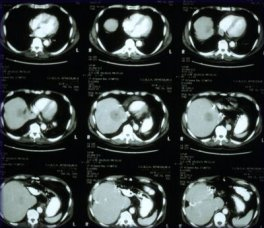
Using radiofrequency (RF) energy to “cook” and kill cancerous tumors without affecting surrounding healthy tissue may provide an alternative to surgery for patients with kidney and other cancers, according to Dr. Bradford J. Wood, a clinical investigator with the Clinical Center’s Diagnostic Radiology Department.
Dr. Wood presented his research at the 25th Annual Scientific Meeting of the Society of Cardiovascular & Interventional Radiology, held this spring.
“Preliminary results look promising for this technique, which is being used on tumors throughout the body, including painful tumors and cancers of the kidney, adrenal, liver, prostate, and bone,” said Dr. Wood.
RF energy is fed to the tumor through a very small needle with an electrode on the tip. The needle is inserted into the tumor under imaging guidance, such as CT scan or ultra- sound. The electrode generates heat up to 100 degrees Celsius. After 10 to 12 minutes of continuous contact with the tumor tissue, the RF energy “cooks” a l-inch to 2-inch sphere, killing the tumor cells. Larger tumors can be treated by cooking overlapping spheres.
The dead cells are not actually removed, but become scar tissue and eventually shrink. Typically, the outpatient procedure is performed while the patient is lightly sedated, and the patient may go home hours later, usually feeling no pain.
RF ablation is a modification of electrosurgery or electrocautery, which has been around at least since the 1920’s, according to Dr. Wood. It is finding a niche in cancer treatment, which increasingly is being customized for each patient based on the size, location, and type of tumor.
Early results from a multicenter study that included the Clinical Center look promising: of 21 kidney tumors treated, 14 (67 percent) were no longer visible on x-ray five months after RF treatment. One patient remains cancer-free 18 months after treatment. For kidney tumors 3 centimeters or less, 1 1 of 14 (79 percent) showed no activity on follow-up.
“Most of these smaller tumors were in patients with recurrent, hereditary kidney tumors. For these patients, RF may provide an effective, minimally invasive option that spares normal kidney and prolongs function,” said Dr. Wood.
In a related Clinical Center study of tumors of the adrenal glands, 10 of 15 tumors (67 percent) showed no active disease, while the remaining patients had some tumor visible on follow-up imaging. All patients treated had x-ray evidence that most of the targeted tumor was killed by the treatment. No major complications were seen. Results are preliminary with only short-term follow-up.
In another preliminary study, RF ablation provided effective short-term pain control in 21 of 24 painful tumors.
RF could eventually be an option for inoperable patients who have not responded to conventional methods, are on high-dose sedating pain medicine, or have had maximum allowable radiation, according to Dr. Wood.
“RF is less expensive, safer, and generally easier than surgery,” said Dr. Wood. “However, without randomized, prospective trials and long-term results, RF is not an alternative to surgery at this point. Surgery remains the proven treatment of choice for most solitary or small liver tumors.”
Collaborating with Dr. Wood on this research are Drs. Tito Fojo, Mac Walther, Steve Libutti, and Christian Pavlovich of NCI.