



The NIH Clinical Center Fine Art Collection
Improving the patient experience at America’s research hospital
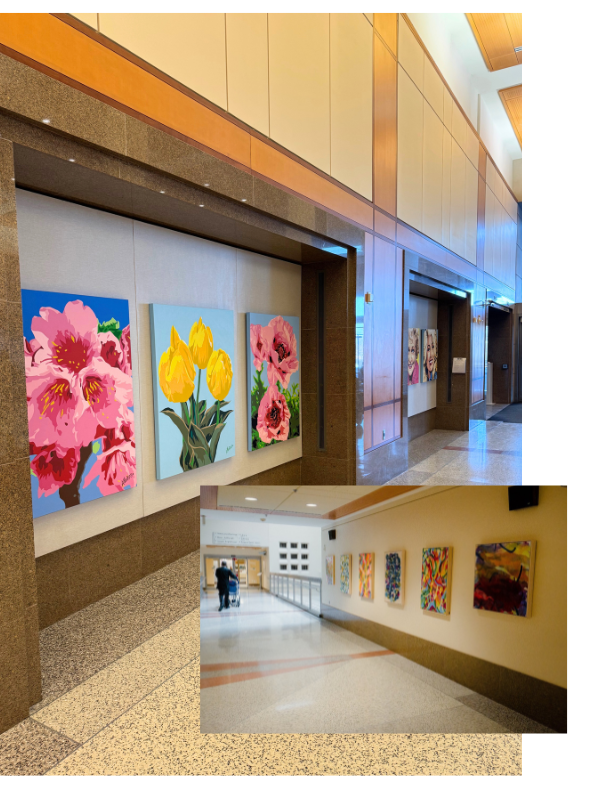 Established in 1984, the Collection of Fine Art at the NIH Clinical Center features a thoughtfully curated selection of original artwork throughout the hospital. Each piece was carefully chosen as a source of respite, hope or inspiration for Clinical Center patients, caregivers and staff.
The collection reflects a variety of mediums, materials, scale and subject matter. Artworks range from oil paintings, watercolors, illustrations and photography to sculpture, ceramics, glass, pottery and textiles.
The program was created in response to a direct patient care need: Staff in a newly constructed oncology unit requested artwork to soothe and distract pediatric patients.
Local By Design
Many museum-quality artworks have been donated or produced by former patients, caregivers, staff and benefactors. Exhibiting artists have been one of our greatest sources for donations. They appreciate being able to show at the Clinical Center and want to give back. The majority of works, however, were acquired over time using construction funds.
While the collection includes several works by towering figures of 20th century American art, such as Louise Nevelson’s soaring iron sculpture Night Sky, the program has focused from the outset on displaying work by local artists.
Incorporating work primarily by Maryland, Virginia and District of Columbia artists serves to foster a unique sense of place at the Clinical Center, one that is rooted in the surrounding environment and community.
This local focus extends to the NIH campus and Clinical Center. The CC Fine Arts program has collaborated extensively with the Office of NIH History and Stetten Museum to establish dedicated space in the Clinical Center for permanent historical exhibits.
Located in highly trafficked central first-floor walkways, these exhibits serve to document, celebrate and share the story of notable NIH and Clinical Center figures and research breakthroughs.
Examples include exhibits on Nobel laureates Marshall Nirenberg, a pioneering architect of plasma cell tumor research; Christian Boehmer Anfinsen, a biochemist who unraveled the mysteries of protein folding; and Harvey Alter, who helped discover the hepatitis C virus, among others.
Fostering Innovation
As with many NIH Clinical Center innovations, other hospitals soon followed its example. Today, more than half of the country’s hospitals have established fine arts programs to enhance their patient experience and work environment.
“If a patient comes across an amazing work of art that is unexpected and it touches them, it’s wonderful to have changed their hospital experience,” Lillian Fitzgerald, curator of the Clinical Center’s Fine Art Collection, said. “Being in the hospital can be very stressful. Thoughtfully selected original art is so much more than a simple distraction; it is a source of healing inspiration and hope.”
Partnerships play a key role in the continued success of the Clinical Center Fine Arts Program. Exhibits have been mounted at the hospital or shared externally in collaboration with the U.S. Botanical Garden, the National Academy of Sciences, the Department of Health and Human Services and the Smithsonian Museum of Natural History, among other federal agencies.
Shows of new artwork are also installed in five galleries reserved for rotating exhibits and change every three months. The regular infusion of new art in these highly trafficked areas creates a sense of dynamism in these spaces.
Artwork on display in the Clinical Center’s temporary galleries is available for sale with a percentage of the proceeds going to the Patient Emergency Fund. Administered by the CC Social Work Department, the fund provides emergency food, housing and clothing to accompanying patient family members in need.
Collection Highlights
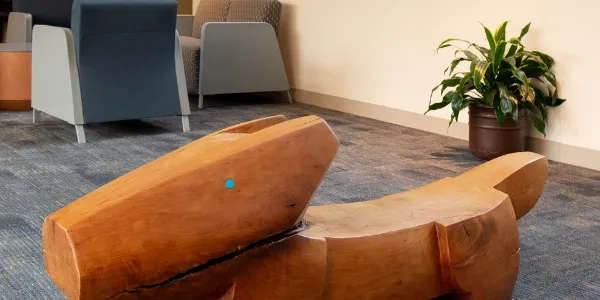
Raya Bodnarchuk
Big Red Dog
Raya Bodnarchuk (1947–2021) was a Rockville, Md.-based artist, who began sculpting animals from clay while still a toddler. As a mature artist, she produced abstract wooden animal figures from shapes that inspired her, often working with a chain saw. Her work is featured in the collection of the Smithsonian American Art Museum.
For many years, Big Red Dog was prominently displayed in the Clinical Center Pediatric Wing.
Bodnarchuk was also a patient at the Clinical Center.
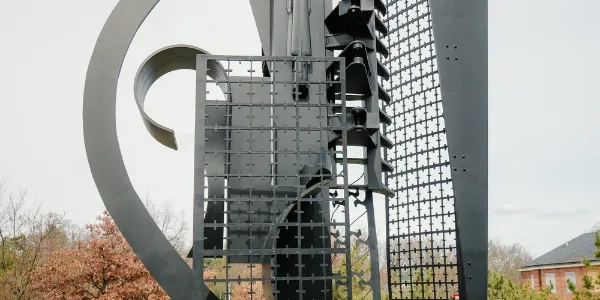
Louise Nevelson
Night Sky
Louise Nevelson (1899–1988) was a 20th century American artist and abstract expressionist known for her large, monochrome wooden wall pieces and monumental outdoor sculptures. Her work appears in the collection of the Museum of Modern Art.
Night Sky was donated to NIH by Edwin C. “Jack” Whitehead (1919–1992), founder of Technicon Corp., a scientific and clinical instrumentation company, and the MIT-affiliated Whitehead Institute for Biomedical Research.
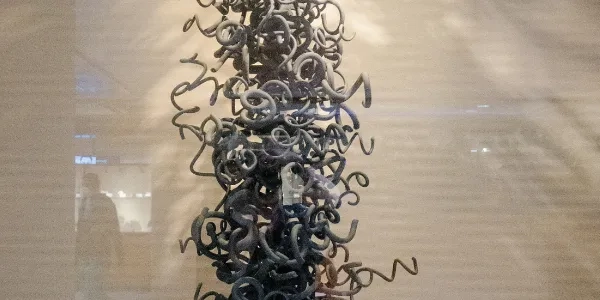
Laurel Lukaszewski
Night 2014
Laurel Lukaszewski is a ceramicist and installation artist based in Prince Georges County. She produced Night 2014 by assembling individual ceramic coils on site at the NIH Clinical Center.
“I am fascinated by repetitive forms found in nature, in patterns that seem to make sense out of chaos. Most of my installations reflect the notion of a moment captured in time, a liberal nod to a concept originally from the Japanese tea ceremony, ichi-go ichi-e, which translated means something close to “in one lifetime, one meeting” or “once in a lifetime.”
(Artist statement courtesy Maryland State Arts Council.)
Gail Watkins
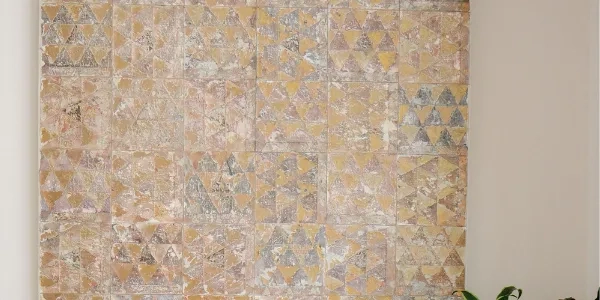
Ca D’Oro
Gail Watkins is an artist based in Annapolis, Md., and a former painting teacher at St. John’s College. Using comics, photocopy, paint and glue, Watkins creates intricately designed paintings that are subsequently distressed with sandpaper, wire brushes or other approaches.
“In the cycle of history, the new is created from the old,” Watkins has said. “It is the natural process of formation and dissolution that interests me and is evident in my work.”
Numerous small triangles of material rise from the surface of Ca D’Oro, creating a three-dimensional texture that changes the appearance of the painting in shifting daylight.
Jolanta Owidzka
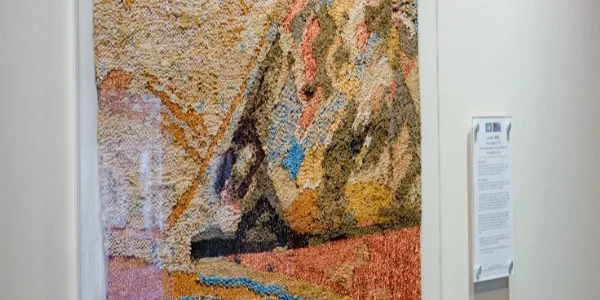
Horizons of Happenings
This work was by donated by Dr. Elisabeth Lejman-Jaworski in memory of her late husband, Tomasz Jaworski, who was a patient at the Clinical Center. Dr. Lejman-Jaworski contacted the CC Fine Arts Program after Tomasz’s passing to express her gratitude at the care her husband received and her desire to donate a work of art from her native Poland in his memory. She ultimately purchased and donated this piece by Jolanta Owidzka (1927–2020), a famous 20th century artist in the vanguard of Polish Modernism. Rejecting the conventions of textile art, Owidzka experimented with compositions made of leather, sisal, copper, Nyland, horsehair and other materials. The weaving exemplifies Owidzka’s discipline and artistic maturity.
Paula Crawford
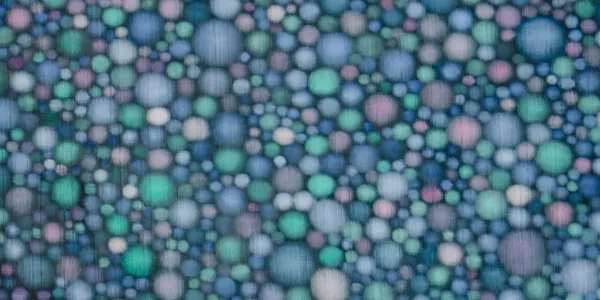
River Cells
Paula Crawford is an artist and professor of fine arts at George Mason University. She was also at one time a Clinical Center patient, who participated in an NIH NIDDK clinical research trial to treat chronic Hepatitis C. Following her treatment, Crawford spent several months painting River Cells with the intention to donate it to the Clinical Center. The artist said she strove to create a painting that evoked water flowing over river stones and also the view of Hepatitis C virus cells through a microscope.
Reflecting on her time at the Clinical Center, Crawford said, “I had the best medical care that I have ever experienced in my life … I encountered a rare and unparalleled combination of organization, competence and kindness. The care to the physical building coupled with that of the doctors and staff become critical to a kind of total experience the patient receives.”